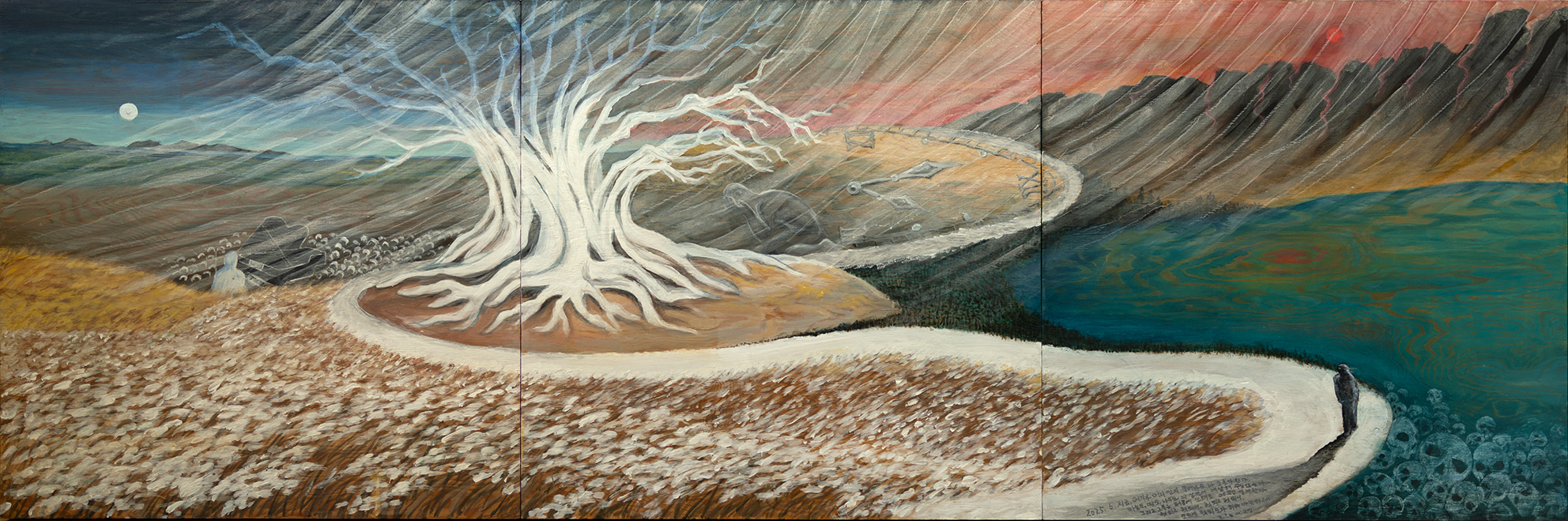
Wind of Legend
2025 Acrylic on grain plywood 360 x 120 x 5cm
Provenance
Artist Collection, 2026
Exhibitions
2026 《In Search of the Forest Spirits》, Yungeun Museum of Contemporary Art, Gwangju, Korea
About The Work
Under the premise that only purely sublimated artwork can commune with cosmic secrets, I contemplate, meditate, and execute my work.
Around 2010, when the long-awaited The Red Book by Carl Jung—whom I deeply revere—was finally published, I was immersing myself in a profound study of his theories on the unconscious. It was during this exact period that I encountered The Secret Life of Plants by Peter Tompkins and Christopher Bird.
These two books provided me with absolute conviction regarding both my personal experiences with trees and the path I was destined to pursue. Furthermore, my recent studies in quantum mechanics have eliminated any remaining shred of doubt from my practice. I have finally found the certainty that evaded me during my decades of wandering as an artist—a clear direction for my contemplation on the relationship between humanity and all things in this world.
Carl Jung requested that his writings on the human unconscious not be published until several decades after his death. When this "shadow consciousness"—which is thoroughly addressed in the deep shamanic traditions present across all cultural spheres—was finally revealed to the world, how many human minds did it liberate? The unconscious within the subconscious that he spoke of shares the exact same context as the Yogācāra (Vijnanavada) philosophy I had studied, representing a profound convergence of Eastern and Western thought. Because Jung had studied Eastern philosophy so deeply, he likely knew that his theories could easily be dismissed by Westerners as superstitious or unscientific; hence, his decision to delay the publication. He synthesized the vast knowledge of both East and West, taking what many would hastily call superstition and defining it instead as the "collective unconscious" hidden deep within the human psyche. This collective unconscious is shared by all individuals, transcending race and gender. In his illustrations, Jung revealed that the sun and the moon, the serpent and the tree, the king and the clown, God and the devil, good and evil—all elements of illusion and reality—coexist within the human soul.
Moreover, this perspective on the unconscious stands as one of the greatest insights in history. By understanding the shamanic or maternal psyche through his partner, Toni Wolff, it served as a catalyst for changing the world alongside the self-actualization of women. Although Jung eventually parted ways with Sigmund Freud over the latter's theory of humanity being repressed solely by sexual drives, this divergence led me to re-evaluate all sentient beings divided into male and female. I began to see the sacredness of that division, and the incredibly diverse cultural and creative achievements born from its potential. Within this framework, I began to focus my contemplation on trees—the magnificent, sentient beings that are alive yet bound to immobility. They have witnessed every transformation of the world and the universe, silently living out their lifespans while participating entirely with their whole bodies.
Furthermore, as I read the grain patterns engraved within them, I followed the Eastern philosophy of Qi (energy). Through deep meditation within the waves of energy generated by "aliveness"—the Qi of change and difference—I received profound messages. It is a magnificent, deeply moving experience to feel the intense energy of the sea, flowing water, trees, rocks, and all living things—manifesting presence out of absence in the empty void. Quantum mechanics has only reinforced my positive embrace of this truth. Particularly in the realm of the science of "Qualia," I have physically experienced communion with pure consciousness, coming to understand that reality is an interaction between matter and human consciousness within the quantum field. Grounded in the foundational principles of Yin-Yang and the Five Elements—an Eastern philosophy of Qi that Jung himself frequently cited—I have communed with the joy, anger, sorrow, and pleasure of these immobile trees.
The reason I utilize the triangle as the shape of my canvas, placing a mirror at its center, is because the triangle is the most stable and flawless geometric form. Since primitive times, this shape—as epitomized by the pyramids—has represented humanity's primordial desire to reach heaven, a pursuit of perfection blending Heaven, Earth, and Humanity (Cheon-Ji-In), making it a deeply symbolic form across various religions. By embedding a mirror within it as a metaphor for the human mind, the structure implies that when three entities gather—becoming more than just a binary opposition—they achieve perfect peace and construct an entirely alternative, ideal world.
Finally, since 1996, this artistic exploration has manifested as a pyramidal kaleidoscope installation featuring three mirrored walls. Stepping inside allows the viewer to feel as though they are floating within an extraordinary, illusionary landscape of cosmic space. Although not implemented in this current exhibition, I have recently integrated digital image projections into this structure for other recent exhibitions.